
How the Operator Pro50 became the go-to K9 collar for Mil/LE handlers in Western Europe
There's a version of this story where I tell you the Operator Pro50 was an instant hit. That handlers saw it, understood it immediately, and orders rolled in from day one.
That's not what happened.
For over a year, the Operator Pro50 sat in the lineup. Barely moving. Not because it was a bad collar — it was the most technically refined thing I'd built. But it was different enough that it took time for the right people to find it.
Then something shifted. The first orders came in from K9 handlers in the Netherlands and Belgium. Word spread through K9 units, and more handlers started ordering and recommending it to colleagues. No marketing campaign. No influencer push. Just professionals talking to professionals.
That's usually how it works with gear that actually delivers.
Why a rigid collar?
Most working dog collars are built from one or two layers of Type 13 webbing, like our Operator D-Ring Cobra45 or the Operator Spine collars. That makes sense for general duty and everyday use — a flexible collar sits comfortably, moves with the dog, and causes no issues.
But under real operational load, flexibility becomes a liability. A soft collar under tension twists. It shifts. It creates uneven pressure points on the dog's neck. In a fast-moving situation — a crowd control deployment, a high-stress apprehension — you don't want a collar that moves around.
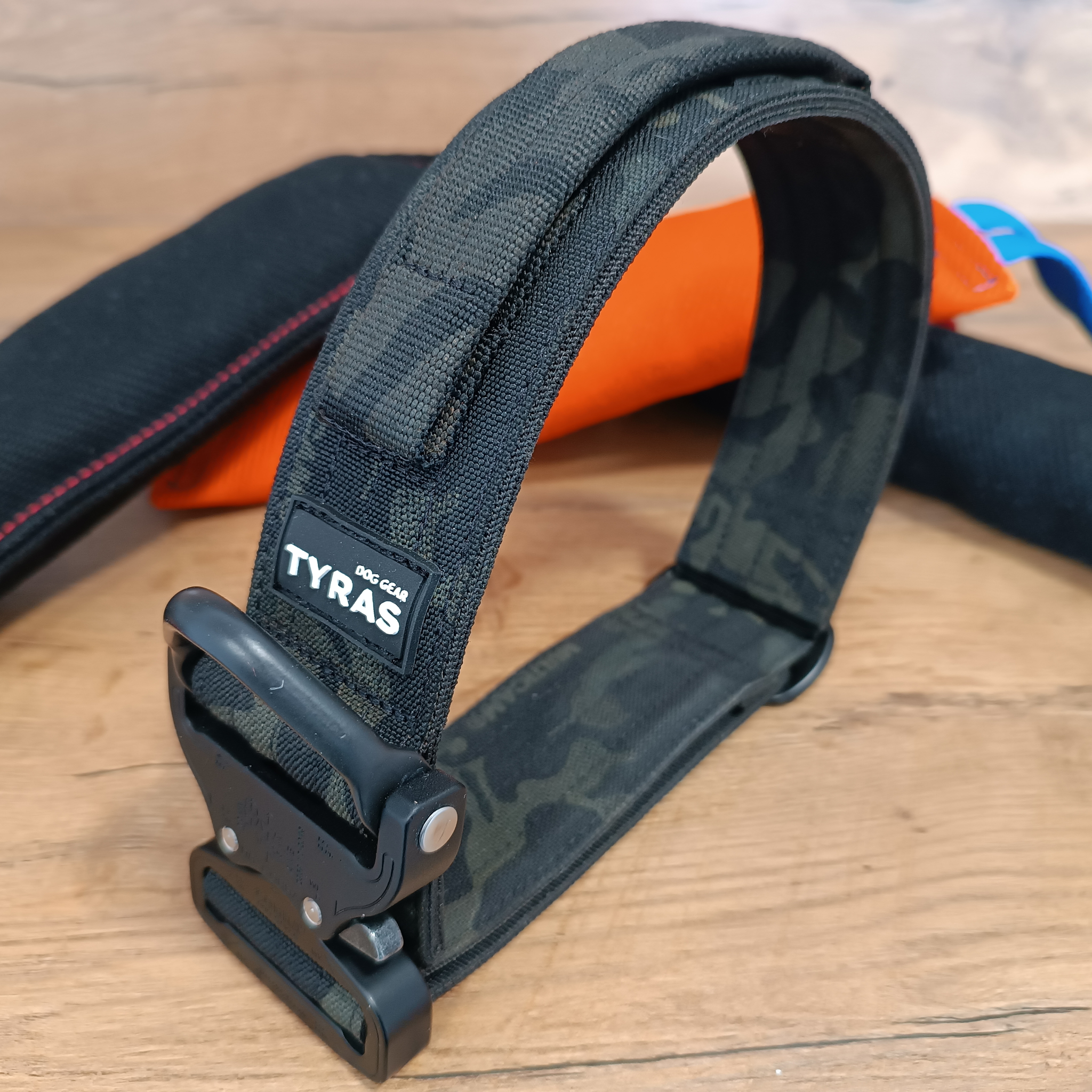
The Operator Pro50 is built around a Scuba webbing core. If you've never worked with Scuba webbing: it's a resin-treated polyamide with a tensile strength of 25 kN and almost no give. Combined with the outer Mil-Spec webbing layer, the result is a collar body that forms a stable, rigid ring around the dog's neck — not a loop that shifts under load.
The collar ends overlap inside the structure and are held in place by two fixed loops. Nothing moves. Nothing slides. The geometry stays consistent whether the dog is calm or going full drive.
The buckle that doesn't touch the neck
One of the details that working dog handlers notice immediately — and that most collars get wrong — comes down to buckle placement and execution.
Most K9 collars position the hardware directly against the neck. This can irritate the dog while working if the fur gets caught in the buckle, or if the metal gets extremely cold in winter. Furthermore, we often see the D-ring placed directly under the handle. Under tension, this setup forces the buckle to rotate backward and press directly onto the dog's trachea. Over time, that causes real health problems.
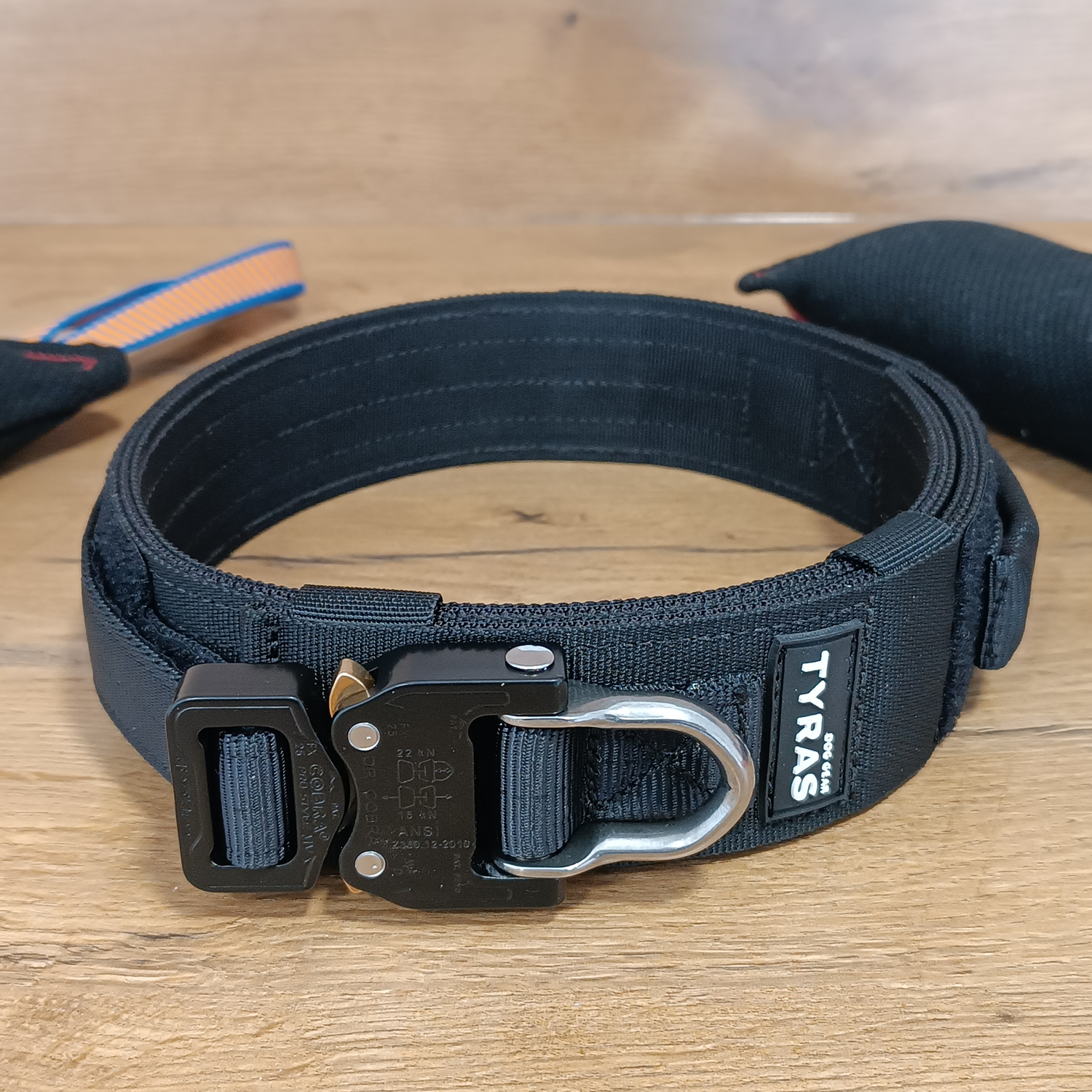
On the Operator Pro50, the COBRA® PRO STYLE D-RING buckle sits on the outside of the collar body. Our construction ensures that metal parts don't contact the dog's neck during normal wear or under load. The 50 mm width distributes pressure across a broad surface area rather than concentrating it at hardware contact points.
The COBRA® D-RING itself is rated at 18 kN and meets ANSI Z359.12-2019 standards. It can only be opened when completely unloaded and requires simultaneous pressure on both clips — accidental release during quick grabs or drive work is essentially eliminated.
The patch panel isn't an afterthought
A lot of tactical collars add a small loop panel as a marketing checkbox. The Pro50's loop panel covers the full outer face of the collar, color-matched to the webbing. But this loop panel isn't this size for fun or just to give more space for patches. It's a structural part of the collar that adds extra rigidity. The Velcro is sewn on flat; when the collar bends around the neck, the panel tightens and stiffens, providing additional support.
In practice, that means name tapes, ID patches, warning patches, or unit identifiers — whatever operational identification your unit requires — fit cleanly without improvised mounting solutions. For handlers working across different units or in multinational deployments, that matters.
The magnetic handle
From size G2 upward, the Pro50 is available with a magnetic self-closing handle.
The handle lies completely flat against the collar when not in use — held by two magnets in the collar body and two in the handle. There is no protruding loop for the dog to get snagged on. But when you need it, it's there immediately.
For handlers who work in dense environments — vehicle work, building searches, tight crowd situations — the difference between a handle that's always in the way and one that appears exactly when needed is a game-changer.
The specs, plainly stated
- Scuba webbing core: Polyamide, resin-treated, tensile strength 25 kN
- Outer webbing: Polyamide Mil-Spec, tensile strength 17.8 kN
- COBRA® PRO STYLE D-RING buckle: Aluminum, 18 kN, ANSI Z359.12-2019
- Integrated D-ring: Stainless steel, tensile strength 22 kN
- Width: 50 mm
- Available colors: Black, Wolf Gray, Olive Drab, Coyote Brown, MultiCam Black, MultiCam Original
- Sizes: G1g through G5 (36–74 cm)
- Handle options: None, magnetic self-closing
- Handcrafted. Lifetime guarantee.
Who it's for
The Operator Pro50 is not a collar for every dog or every handler. It's heavier than an everyday collar. It's stiffer by design. It costs more than most collars on the market.
It's built for working dogs in active service — dogs that train hard, deploy regularly, and need equipment that performs consistently under conditions that would destroy lesser gear.
If that describes your dog, it'll probably be the last collar you buy for a while.